Showing posts with label freebie. Show all posts

7.20.2017

Place Value Parade: My Favorite Tactile Number Building Activity

 As any new or veteran teacher can tell you, understanding place value is the foundation of building solid number sense. It is the base of all math understanding.  It is essential and vital to further mathematical understanding. Basically, it is just really really important.


I always enjoy teaching place value and incorporating hands-on activities whenever possible. Recently, I gave one of my ALL-TIME favorite place value tools, Place Value Parade, a much needed update and a colorful makeover. This math number building concept activity is a great way to help your students understand place value in a fun, hands-on way.

Place Value Parade is very simple and the kids LOVE it.  It helps kids build their math vocabulary, master place value, and improves listening skills.

Place Value Parade is an interactive hands-on place value chart.  To get started, make copies or print your choice of Place Value Parade charts. I always laminate mine so that kids can write on them with Expo markers.


Have students cut along the dotted line to separate the digit cards from the place value chart. Then, have students cut out all the numbers to create single digit number cards.
Now, you are ready to begin.  It is time to build some numbers.

I like to give my students clues that fill in one digit at a time.  This is a fun way to review math vocabulary, do a little mental math, and turn it into a game.

Here are two examples of a Mystery Number Riddle:


My students think it is great fun to listen to the clues and figure out the mystery number.  We check each digit before reading the number aloud and you will hear the whole class go "Yesss!!" after we call each digit.

Your clues can be simple or very complex.  I like to use as much math vocabulary as possible. (greater than, less than, sum, difference, double, half, more than, less than, even, odd, product, quotient, etc.)

After building the number, read the number together.  Write it in expanded or word form.  Discuss the value of each digit. Etc.


My students keep their digit cards in a plastic bag and the place value chart in their math notebooks.  We use them for about a week solid and then pull them out about once a week for review.  If numbers go missing, we switch to just using Expo marker on the boards.

Students really enjoy building numbers and writing their own mystery number riddles for others to figure out. This activity works great in tutoring or small groups and is even if fun fast-finisher activity for partners.

https://www.teacherspayteachers.com/Product/Place-Value-Parade-Understanding-Place-Value-721993

Of course, you can do this very same activity on white boards or notebook paper.  I like the tactile model I showed you above and so do my students. Plus, the place value charts come in handy as a regular ol' math tool all year long. It's a great visual for the kids. 

https://www.teacherspayteachers.com/Product/Place-Value-Parade-Understanding-Place-Value-721993

If you are interested in using the place value charts from above, you can grab this activity as one of my stores forever freebies here. There are now 4 different styles of place value charts included in the resource in both color and black and white, giving you a total of 8 option! Enjoy and have fun 

Happy Teaching,


Place Value Parade originally appeared on my blog, The Teaching Thief, 1/27/13

6.30.2017

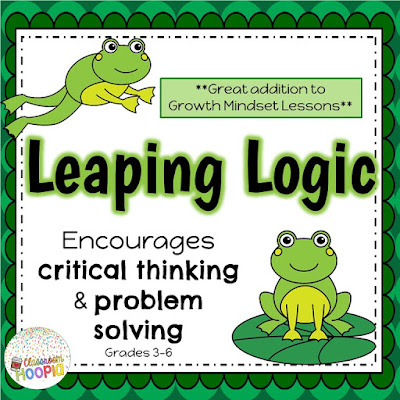
A Logic Puzzle for Growth Mindset

https://www.teacherspayteachers.com/Product/Leaping-Logic-Puzzle-813704

Are you looking for a fun way to encourage problem solving and critical thinking in the classroom?
How about a fun hand-on brainteaser to add to your growth mindset lessons? I know just the thing.

It's an old frog hopping game that can be found in many variations. In my classroom, we call it Leaping Logic and it is one of my all time favorites.

Simple in design, yet more difficult than you might imagine - my students love this challenge!

I use the game board below.

https://www.teacherspayteachers.com/Product/Leaping-Logic-Puzzle-813704

I  teach Leaping Logic at the beginning of the year during one of my growth mindset lessons.
The puzzle is not easy to figure out, but that is (of course) the challenge! And...There is no greater success than figuring out the pattern and being able to recreate that pattern. Many versions of this game can be found online and through an app, however I still prefer to play on paper and use manipulatives.

To set up your game board, you need 8 game pieces in 2 different colors. I like to use the two-sided math counters. Put one color on one side and the other on the other side. The counters represent the frogs - red frogs and yellow frogs. 

It should look like this.
Your objective is to move all the red counters to where the yellow counters are and vice versa.

To play, you can move any counter you want, but you must follow these rules.
  • You can only move each frog forward - never backward.
  • You can leap over 1 frog at a time.
The puzzle has been solved when both colors on the board have switched places and the rules have been followed.

Some students do get frustrated. It helps to break it down into steps and start by switching one of each color successfully. Then, try switching two of each color successfully and so on. As they say, how does one eat an elephant? One bite at a time. This is the same thing. By starting small and building upon each small victory, students are able to solve the puzzle and feel the success of perseverance and grit.

Want a hint?!?  Never move two frogs of the same color next to each other. Keep the colors alternating. 

https://www.teacherspayteachers.com/Product/Leaping-Logic-Puzzle-813704
After students know how to play, I leave this brainteaser in my math games area all year and kids continue to play. They love it! If it has been awhile, I see them reteaching themselves the pattern and if they have it mastered they start solving for speed and racing each other.

Each year I have to reteach myself the pattern. I know the rules. I know the hints. And yet, I still have to think. That's why it is engaging all year long. It's just like the triangle peg game. You can play over and over again.

If you are interested in adding this fun little brainteaser to your back to school goodies, just click any of the pictures above or here to download it for free from TPT.  Let me know if you use it in your classroom. I'd love to hear how it went. Tag me on Instagram @classroomhoopla !

Happy Hopping!


Leaping Logic first appeared on my blog The Teaching Thief 9/6/2013

    6.19.2017

    Student-Led Absent Work Form


    https://www.teacherspayteachers.com/Product/Absent-Work-Form-1982761

    Efficient, easy to use classroom forms bring me joy! Pure teacher joy!  

    This summer I wanted to share some of my favorite classroom forms that I use ALL THE TIME. Anything I can do to make my classroom run smoothly is a priority and anything that gives students ownership of our classroom routines and procedures is a huge win. 

    Today's favorite form does both of those things.

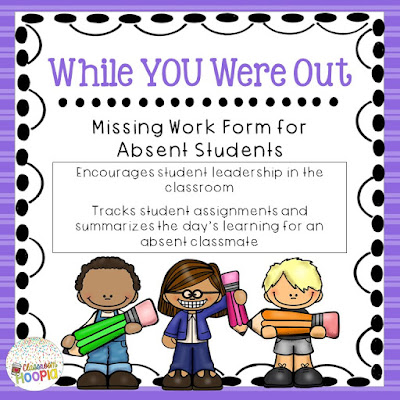
    We all have absent students, right? Of course we do. This form is your standard missing work form, with one teeny-tiny difference.  It is designed for a student to complete for another student. This is one of the MOST IMPORTANT leadership roles in my classroom.  

    Each day, if someone is absent, my most organized, detail-oriented, natural born teacher helpers (you know the ones) are assigned one student to complete this form for. Throughout the day, they keep track of our learning objectives and assignments. At the end of the day, everything gets paper-clipped together and left on the absent student's desk waiting for their return. When that child returns, I direct all questions about missing work to my detailed-oriented natural born teacher helper first, then jump in as needed.  They clarify questions from the attached work and get the student caught up. 

    Students helping students. Leaders being leaders.  

    It's a great system and doesn't take long before it runs itself.  

    I started using this form two years ago and I have gotten great feedback, not only from students, but from parents as well.

    This classroom form has saved me so many headaches. My student leaders have been amazing about completing them.  I can't believe there was a time in my teaching career when I didn't use some kind of form to help my kiddos who missed a day or two. This keeps all their work together, gives them an expert to consult (who's not the teacher), helps get them caught up asap, and fosters an environment of leadership and community.

    Game changer. 

    If you are interested in the form I use, click the images above or right here to download it for free from TPT. I hope it is as helpful in your room as it has been in mine.


    6.12.2017

    Classroom Bingo for the Win!


    One of my favorite classroom management systems is my Class Bingo Board. I have been using this simple system for many years and it works great with kids of all ages. Not only is it perfect for teaching procedures and routines, but this board can be used to celebrate attendance, books read, stories written, or math facts mastered. The possibilities are endless making it a teacher and student win!

    How It Works:

    As a class, decide on a goal. This could be a routine or procedure like lining up quickly and quietly or demonstrating good manners at the lunch table. Every time the whole class is successful with the goal, a student gets to draw a number card. The student will then cross out, color, or mark that number out in some way. The class keeps playing until they earn a bingo. Then, you have a class celebration and begin again.


    I love that the whole system is very student driven. They choose the goal. They demonstrate the behavior. They critique their performance. They draw the numbers. They earn their reward.

    I created by Class Bingo Board years ago and it still looks good. Originally, I made my board by modifying a classroom calendar and adding calendar numbers to match.  With a few snips here and a little glue there, it came together perfectly. I also purchased paint splatter mini accents for my class to use as markers on the board. Everything was laminated and it has stood the test of time!


    This simple management technique can be used anytime, anywhere.
    • Draw a bingo board on a white board
    • Create a bingo board from supplies 
    • Or download my Class Bingo Resource for free and start using it today!
    https://www.teacherspayteachers.com/Product/Class-Bingo-A-Positive-Classroom-Managament-System-Using-Goal-Setting-3198116 

    This resource includes 6 varieties of bingo boards all in black and white. You can copy on bright colored paper, or copy on white paper and color squares as you go. You can use one board at a time or run several bingo boards at once. The options are endless!

    Included:
    • 16 Square Plain, Goal Focus, Class Focus
    • 25 Square Plain, Goal Focus, Class Focus

    Plus – there are number cards for each type of board provided.


    Simply print and go! You can color the squares, stamp the squares, use magnets to cover the squares, or put stickers on the squares.

    So many options. So many uses. A great tool for every elementary teacher.


    Classroom Bingo first appeared on my blog, The Teaching Thief 7/30/11

    Classroom Hoopla Instagram

    Popular Posts